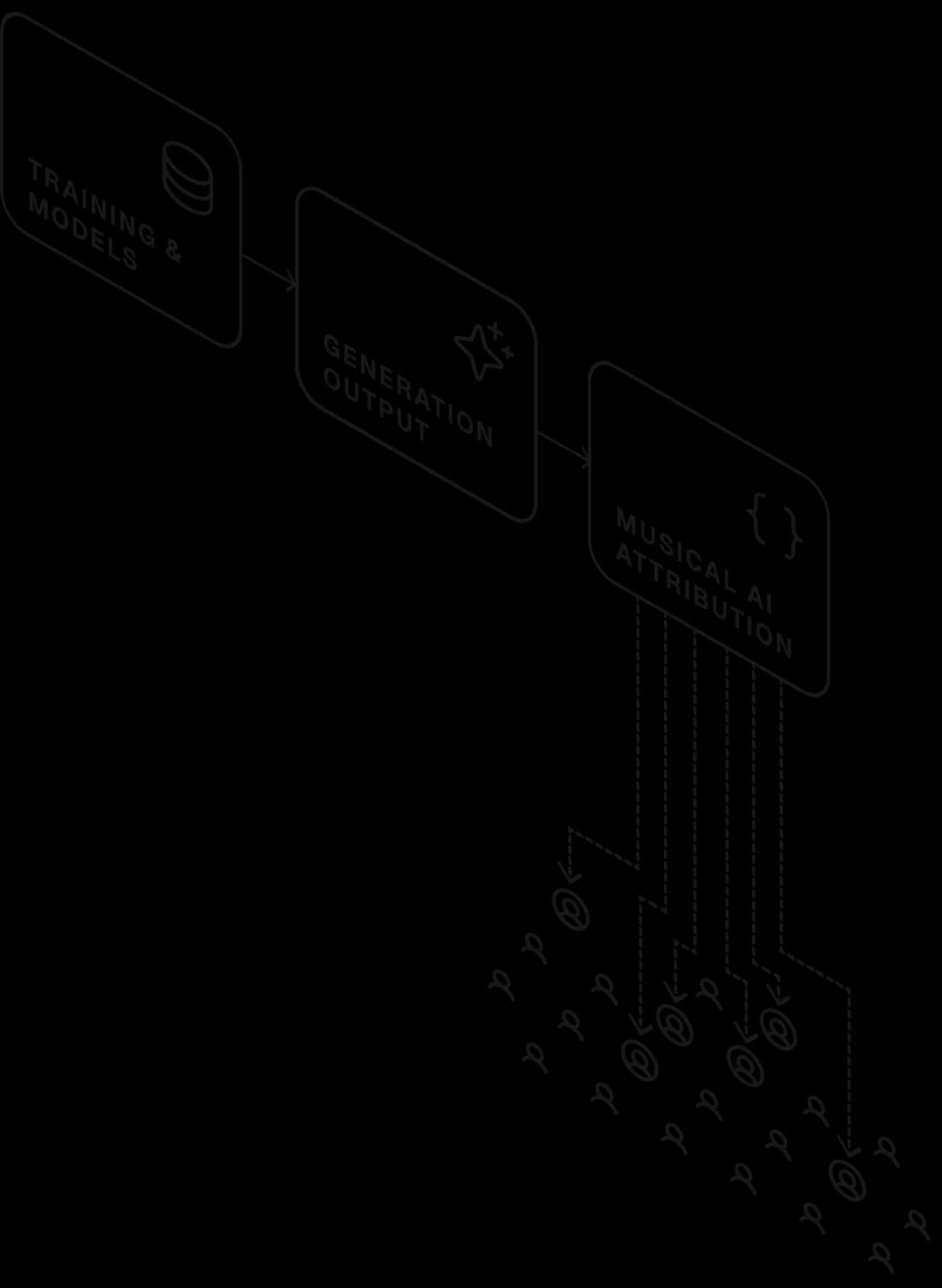
Attribution means influence, not detection

Attribution means influence, not detection

Traditional attribution answers one question:

Did this output match a known work?

Generative systems require a different perspective:

Which licensed material influenced this output, and by how much?

Musical AI measures proportional influence at the output level

Attribution happens

downstream by design

Training pipelines and model internals are proprietary, volatile and unnecessary for licensing decisions.

We operate at the output boundary where content becomes real and attribution actually matters.

Attribution is tied to each generated result.

We measure proportional influence per output

We measure proportional influence per output

We measure proportional influence per output

For every AI generated output, Musical AI calculates proportional attribution across all contributing sources.

The total always sums to 100%, reflecting how licensing agreements actually work.

Music rights aren't monolithic.

Master and publishing rights are handled separately

Musical AI computes attribution for sound recordings and underlying compositions independently. Both are produced within the same system and reported separately. No abstraction, just alignment with how real contracts work.

Built to stand up to scrutiny

Every attribution record is repeatable, evidence-linked, and traceable to concrete output segments. All records are retained for audit and inquiry. Not a probabilistic guess. A defensible system of record.

Built to work at scale

Musical AI prioritizes repeatability over novelty, auditability over theory, deployment over research purity. That's what makes it work in real licensing environments—not just in demos.

Minimal surface area

It’s our integration philosophy.

Musical AI integrates once, after generation. Send outputs or output representations, get attribution results back. Sensitive data can stay fully in-house. No model access. No training data exposure. No pipeline changes.

What we don’t do

Musical AI doesn't inspect model weights or gradients, train or fine-tune models, determine infringement, or enforce policy and takedowns. We measure influence. You decide what happens next.

When attribution becomes a system constraint, we should talk.

A short conversation is usually enough to determine fit.

Request a conversation

Request a conversation

Request a conversation